
Shedding Light on Experiential Learning: How a 3D-printed Laser Baton is Transforming Music Education at UWG Share this page
At the University of West Georgia, hands-on learning is taking on a visual dimension in the music program, where an innovative tool gives student conductors immediate feedback on their movements. Developed by Dr. Josh Byrd, professor of music and director of bands, the “laser baton” device – a custom, 3D-printed conducting wand with integrated lighting – has earned UWG’s first provisional patent, equipping student conductors with the precision and confidence needed for professional careers.
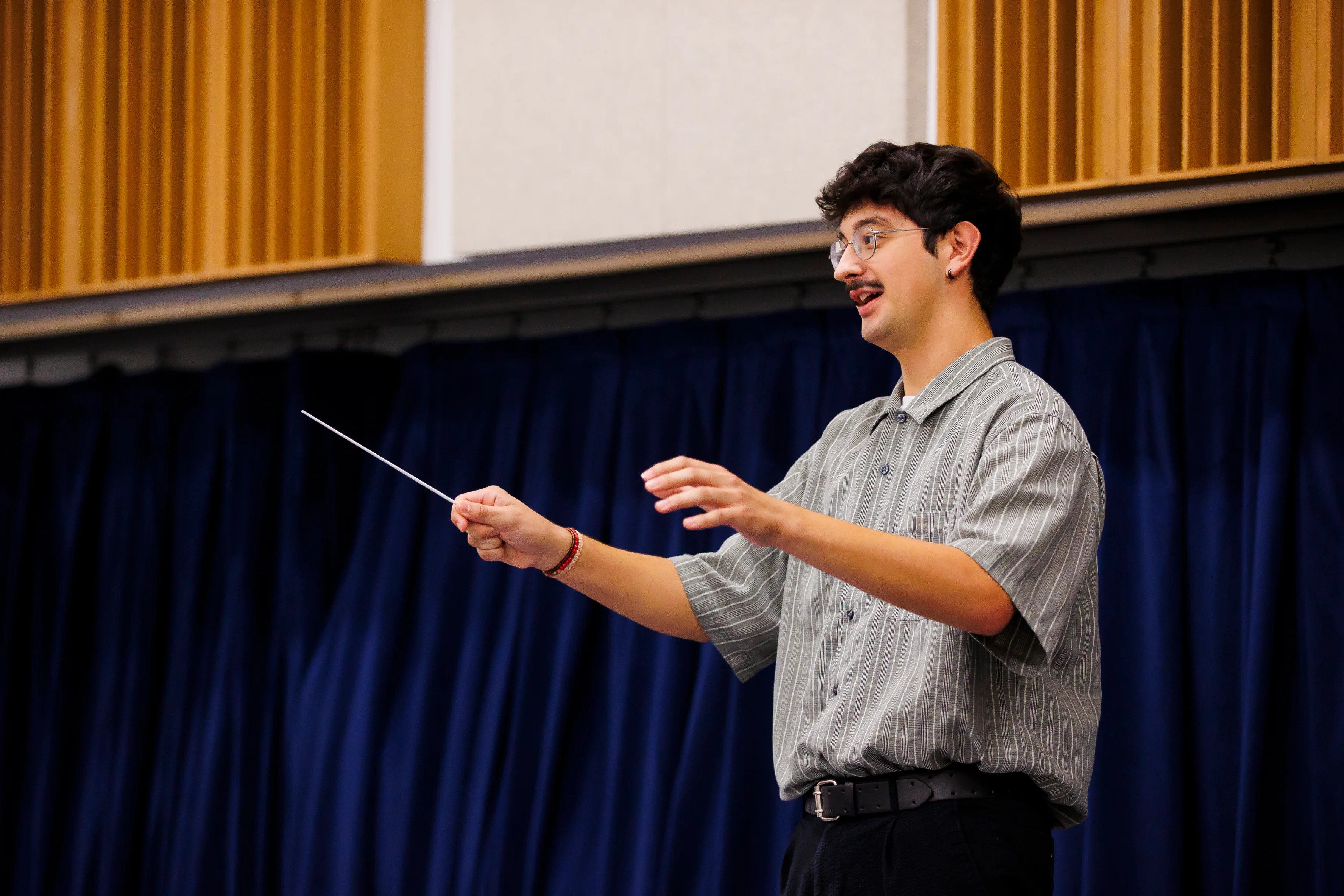
Conducting is a delicate, complex physical art form that involves far more than waving a wand. A conductor must coordinate the back, shoulder, arm, elbow, wrist and fingers to move the baton at a consistent speed in fluid, precise motions. Traditionally, however, students face a quiet, solitary challenge during practice. Without an ensemble present or a video camera recording every angle, it is nearly impossible for a novice conductor to see what their baton is signaling.
“Aside from having a group in front of you – and even this is not a perfect system – there’s no way to get instant feedback while practicing, particularly conducting patterns and articulations,” Byrd explained.
To bridge this gap, he designed the baton handle with a specialized laser pointer, making the invisible path of the conductor’s gesture instantly visible on any wall or music stand.
Creating a solution to this challenge required two decades of work, with lots of trial and error, as well as interfaculty campus collaboration. Byrd first envisioned using lasers 20 years ago, but his early attempts with cat toy lasers failed to replicate the balance and weight of a genuine baton, thereby limiting their usefulness.
“When you hold something that feels like a baton, you can involve your fingers and wrist in nuanced ways that create natural and comfortable motions,” Byrd said. “This is like a kindergartner holding a pencil versus an adult: the child is developing fine motor skills and can only write using larger, blocky motions, while the adult can use all of the joints in the hand to draw more complex shapes smoothly and evenly.”
Then, Byrd discovered a tiny 9mm pistol bore-sighting laser small enough to fit inside a sleek handle, describing this moment as a breakthrough. Working alongside Witt Teem at The Garage, Byrd developed a handful of early prototypes. A grant from UWG’s College of Humanities, Arts and Social Sciences’ Innovation and Impact Funding, supported by Interim Dean Clint Samples, subsequently enabled the purchase of a 3D printer, which allowed Byrd to mass-produce handles – 30 in just 10 hours – and shift the focus to student learning.
The technology replaces guesswork with immediate visual clarity for music students like Ethan Butler-Paige. Practicing conducting in isolation can often feel intimidating, as students grapple with subtle physical mechanics without knowing if their setup is correct. This can create mental obstacles to solo practices, but the laser baton provides a solution.
“The laser provides immediate feedback,” Butler-Paige said. “On a regular baton, I would most likely need a video or another person to tell me that my hand position is off. With the laser baton, I can see if my wrist isn’t starting the movement or if my fingers aren’t engaged enough – all from how the laser reacts to my gesture. This allows me to make changes quickly, before the incorrect setup becomes a habit.”
Butler-Paige utilizes the light beam to refine delicate articulations and movements, such as matching flick depths between prep beats and downbeats. By removing the uncertainty from solo practice, the tool helps build student confidence, and in tandem instills healthy physical habits that support career longevity.
“The laser baton takes some of the unknown out of learning something new,” Butler-Paige shared. “When I’m able to get visual feedback instantly, it makes me feel more open to practicing.”
The device has also transformed instruction in the classroom. By projecting the laser beam against rehearsal hall walls, Byrd noted how he can now demonstrate fluid speed and motion for an entire class at once. Students visually track the beam trajectory and replicate it in real time, rather than deciphering subtle hand movements from a head-on perspective.
In addition, beyond boosting student confidence on campus, the project represents a major milestone for university research and national outreach. Securing the provisional patent, however, was an emotional roller coaster. After facing weeks of frustrating hurdles while attempting to file on his own, Byrd admitted he was nearly ready to give up.
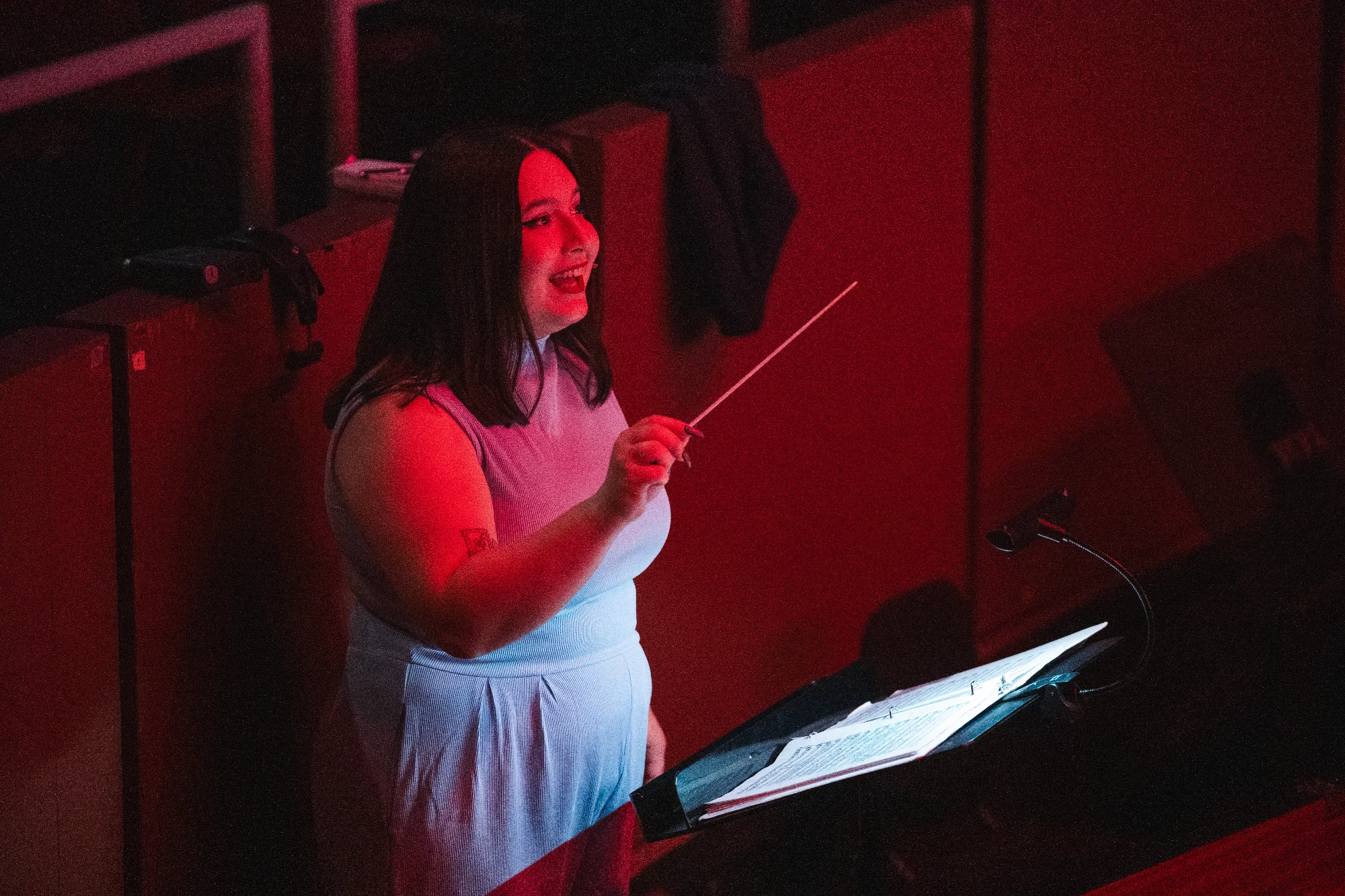
A chance conversation with Dr. Jon Preston, provost and senior vice president of Academic Affairs, redirected him to UWG’s Office of Research and Sponsored Projects, where he partnered with Dr. Brian Mosier, Dr. Mark Clarke and Raja Bhattacharya. Together, they expanded the concept into an in-depth 22-page provisional patent application that also covered broader educational and technological applications. Now backed by university leadership, Byrd is preparing to demonstrate the prototype at universities and conducting symposiums and conferences across the country.
However, the profound human impact of the project can also not be understated. Recently, a colleague at the University of Illinois introduced the laser baton to a visually impaired student. They described the high-visibility prototype as a “game changer” for observing baton trajectory.
“Hearing that something you envisioned so long ago is now helping someone you’ve never met overcome an obstacle is a surreal moment,” Byrd reflected.
photography by Hailey Wilkinson