
Bridging No Gaps: Alumnus Valdes’ Teaching Journey at UWG Share this page
During Alan Valdes’ undergraduate years at the University of West Georgia, a professor once teased him that he was “always trying to write history disguised as philosophy.”
It was a joke that stuck with him.
“I remember that little moment echoing into my thinking quite often as I decided what graduate subject to pursue,” noted Valdes ’23 ’25. “I always enjoy reading about these little idiosyncrasies of past figures, the oddities and anecdotes that humanize them and subsequently bring great color to the collective human drama that history represents.”
He added that his love of history largely comes from de-mythologizing historical figures.
Now, as an alumnus with a master’s degree in history and experience as a former graduate teaching assistant (GTA), Valdes has moved from a student to an educator, inspiring the next generation of young minds.
After teaching dual enrollment American history courses at Heard County High School during graduate school, he developed a passion for the classroom and elected to remain with the program after graduation as a part-time instructor. He has grown to reject the traditional, lecture-heavy approach and now fosters a lively environment focused on active learning within his classroom, where he aims to give dual enrollment high school students an early taste of college.
Valdes started his journey at UWG pursuing an undergraduate degree in philosophy. After achieving this goal, he chose to obtain a master’s degree in history from UWG, a choice largely dependent on his relationship with professors and faculty in the School of Humanities. The school’s director, Dr. Robert Kilpatrick, first made him aware of the dual enrollment teaching opportunity. Dr. Charles Lipp, his mentor, and Dr. Colleen Vasconcellos supported him during his first experience teaching in Heard County.
Valdes jumped at the opportunity to gain hands-on experience, having been a dual enrollment student himself. He keeps his own experiences in mind when it comes to his philosophy with teaching. He rejects the idea of an inherent gap between the capabilities of high schoolers and college students.
“If a high school student taking a college course feels that the instructor is bridging that gap, it can be discouraging,” Valdes said. “Are they not a college student taking a college course?”
He emphasized that this is something he tells his students on the first day of class. He explained that by refusing to reify this gap in his classroom, his students become better prepared for college when they graduate high school.
Valdes’ experiences have not come without learning opportunities and challenges. He reflects that the most difficult part of his experiences as a GTA was classroom organization, referencing a saying commonly attributed to Napoleon that “the novice studies tactics, but the true professional talks logistics.”
He reflected that during his few weeks teaching on his own, he fell much more into the former, referencing how, at first, the students tore apart his syllabus. However, he handled this by adapting to the students. If one is going to treat high schoolers like college students, Valdes believes, they should receive college experiences.
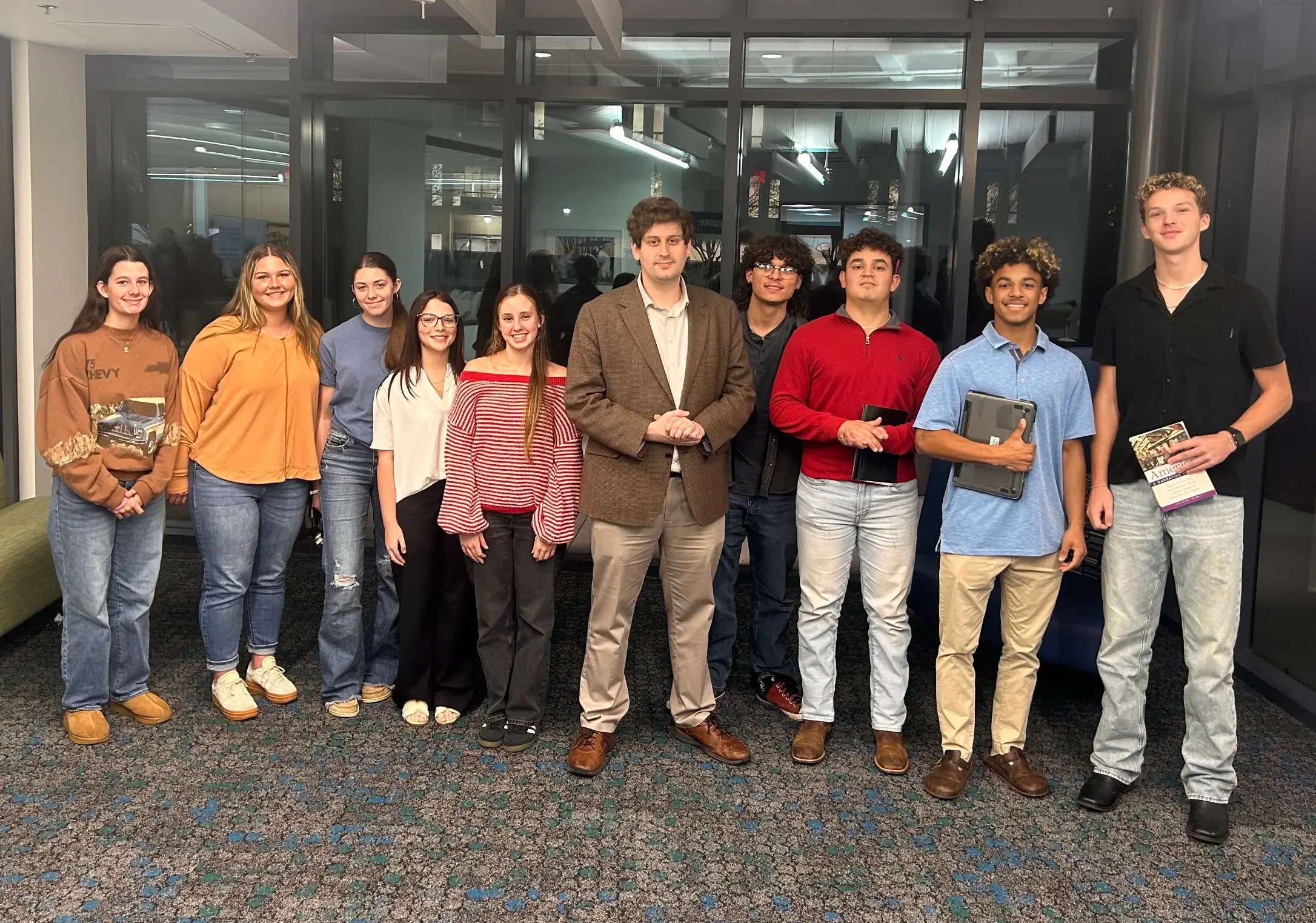
This all culminated with what he deems to be his proudest moment so far from his teaching career. During the annual Ferling Lecture series at UWG in 2025, many of his Heard County students attended. Dr. John Ferling, who the lecture series is named after, gave a talk, and Valdes’ students actively participated in the academic discourse by asking Ferling a few questions.
Valdes believes that history matters to local communities, which is another driver of his continued engagement with the program. In his own American history courses, he orients the content around the question of how someone prepares for the responsibilities of being a fully engaged citizen.
Embodying the “Go West” spirit, he advised students to reflect on their own experiences.
“Once someone reflects on what made a class effective for them, you can’t go wrong by trying to emulate it,” Valdes concluded. “You will discover yourself inside the classroom, no matter what discipline you study.”