
At the Crossroads of Innovation and Humanity: UWG’s Orsega Named Governor’s Teaching Fellow for 2026 Symposium on AI and Human Skills Share this page
Selected as a Governor’s Teaching Fellow (GTF) for the 2026 symposium, “Generative AI Skills and Human Essential Skills,” the University of West Georgia’s Dr. Michael Orsega is stepping into a statewide conversation about the future of learning – one that asks how emerging technologies can elevate, rather than eclipse, the human connections that define great teaching.
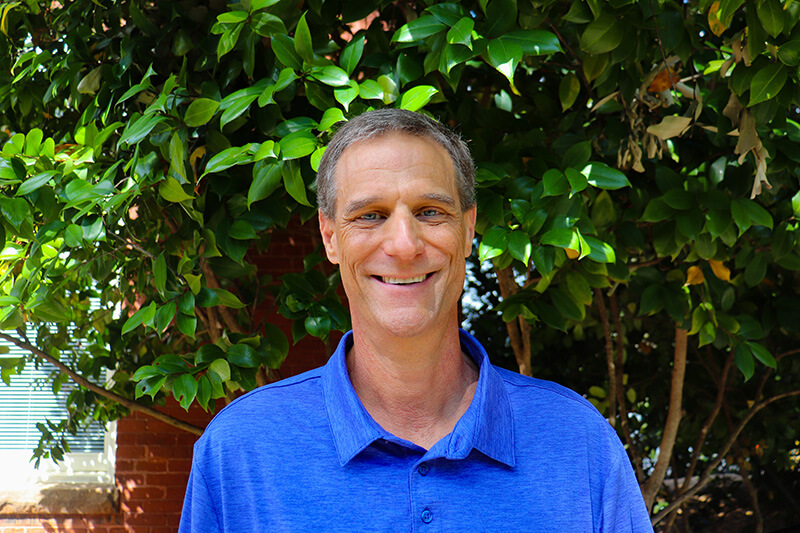
As one of 16 college faculty members across the state, Orsega was selected in this highly competitive forum that included a diverse representation of Georgia institutions and disciplinary fields.
“Generative AI is here to stay, and as educators, we cannot ignore it,” exclaimed Orsega, a computer science professor who said he noticed students using the technology and wanted to get better details of how it’s used and how he could better use it for instruction. “It’s up to us to help show students appropriate times and ways where it can be used.”
Generative AI is a computer technology that can make new things – like writing, images, music or even bits of code – based on what a user asks it to do. It learns by studying large numbers of examples, spotting patterns in how those examples are built, and then uses those patterns to create something original from a simple text prompt.
Computer science students are often early adapters of AI technologies but balancing that technical proficiency with essential human skills like critical thinking, ethical reasoning and communication could create a gray area around certain disciplines.
“My cohort consisted of faculty from all departments, and I found their perspectives on generative AI most interesting, especially from the arts,” Orsega recalled. “Arts faculty noted that both they and students felt it was taking away from their human skills and creativity. In contrast, that is something that I don’t see with my students. I believe it’s up to me to help motivate the art and pride in software development that is unique to each individual.”
Orsega also said he felt it was important to demonstrate not only where GenAI is useful but also to point out where it’s lacking – with one caveat of reminding people that if computers could just generate any and all results, there would be no need for developers.
“It’s critical to realize that AI is just processing and compelling results from existing content; it’s not creating anything new,” he explained. “The use of AI is great for those who have a solid understanding of the results, including being able to tell when they’re not accurate. The key is building a solid foundation, without AI producing answers first. Students will then be prepared to more critically evaluate the results provided.”
Problem solving and critical thinking will become even more essential as AI grows more capable and complex in higher education, Orsega hypothesized. Because students can now ask generative AI for quick answers, it may be harder to motivate them to work through challenges on their own, which is where real learning happens. As a result, people who can think deeply and tackle problems independently will be in even higher demand across all fields.
Orsega advises his colleagues to investigate how students are already using GenAI in the classroom and leverage that.
“Every course is different, and faculty are the ‘boots on the ground,’” he said. “They know the best way AI can be used in their courses. It may mean demonstrating areas where it isn’t reliable. But students are already using it, so it’s important to educate them – and ourselves – on using it responsibly. Technology is constantly changing. There are times when it can be challenging to keep up, but that’s part of what we do.”
For Dr. Nate Bickford, UWG’s new dean of the Dr. James “Earl” Perry College of Mathematics, Computing, and Sciences, Orsega’s selection represents more than an individual honor. It reflects the shared commitment across campus to blend innovation with the human skills students need most.
“Coming from a biology background, I have seen firsthand how emerging technologies can transform every academic discipline, and GenAI is no exception,” he concluded. “Dr. Michael Orsega’s selection as a Governor’s Teaching Fellow reflects his excellence as an educator and his commitment to helping students thrive in a rapidly changing world. The intersection of GenAI and essential human skills is one of the most important conversations in higher education today, and we are proud to see Dr. Orsega representing UWG in this important work.”