
A Major in Minds, a Minor in Mischief: UWG Psych Alum Celebrated on National Cartoonist Day Share this page

As the U.S. recognizes National Cartoonist Day on May 5, University of West Georgia alumnus Mark Buford ’86 is proof that sometimes the sharpest insights into human behavior come not only from a textbook, but also from a perfectly timed cartoon. With a psychology degree in his back pocket and a sketchbook never far from reach, he’s turned everyday quirks into art that makes readers laugh, pause and see themselves a little more clearly.
Mostly known for the internationally syndicated daily comic strip “Scary Gary,” Buford said his studies in human behavior played a pivotal role in his creations.
“For a long time, I regretted never having used my psychology degree,” he confessed. “But the more I create comics, I realize I’m using it all the time to create layered and interesting characters.”
His path from psychology to cartoons started after graduation in the late ’80s when he developed an interest in stand-up comedy.
“I was an open-miker, battling stage fright and struggling through my eternal five minutes on stage every Wednesday night,” he recalled. “At that time, comedians like Jerry Seinfeld, Jay Leno and Garry Shandling were still on the regular tour circuit. They’d perform in Atlanta periodically and were happy to mentor us. Seinfeld was always particularly approachable and gracious.”
With his panic unrelenting, Buford hunted for fresh comedic outlets. He’d grown up sketching his favorite comic, “Peanuts,” and his first original pieces fused underground comics with stand-up energy.
“I became completely engrossed,” he said. “The way the artists were able to tell stories with gentle, dramatic arcs and conversational dialogs was a real eye-opener for me. Those were the types of comics I was attempting to draw when I began putting pen to paper.”
Graphic Novel Sample
This sample from Buford’s upcoming graphic novel shows the kind of visual storytelling that shaped his early approach to comics.
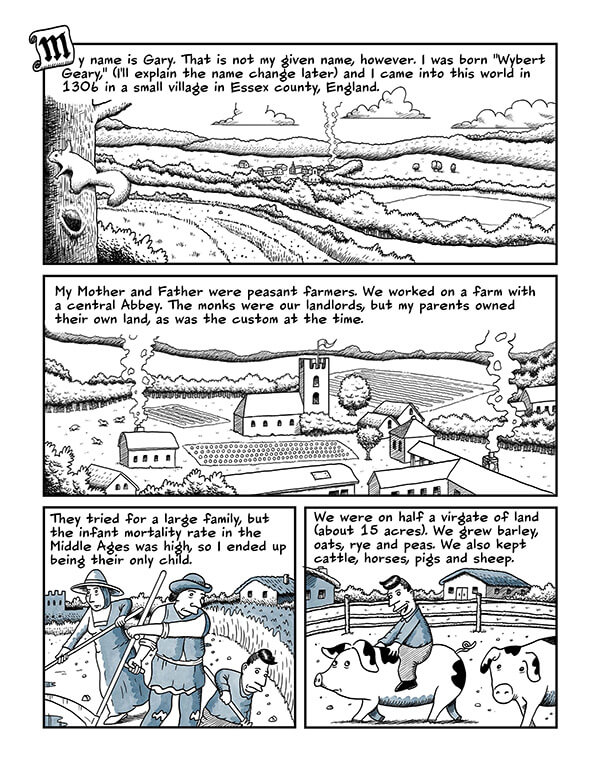
Read transcript and image description
Panel 1
A medieval-style countryside scene shows fields, hedgerows, birds and a small village in the distance.
Text: “My name is Gary. That is not my given name, however. I was born ‘Wybert Geary,’ I’ll explain the name change later, and I came into this world in 1306 in a small village in Essex County, England.”
Panel 2
A farm village appears around a central abbey, with fields, houses, animals and smoke rising from chimneys.
Text: “My Mother and Father were peasant farmers. We worked on a farm with a central Abbey. The monks were our landlords, but my parents owned their own land, as was the custom at the time.”
Panel 3
Gary’s family works in a field with hand tools while a dog stands nearby.
Text: “They tried for a large family, but the infant mortality rate in the Middle Ages was high, so I ended up being their only child.”
Panel 4
A young boy tends pigs near a fence, with other livestock and village buildings in the background.
Text: “We were on half a virgate of land (about 15 acres). We grew barley, oats, rye and peas. We also kept cattle, horses, pigs and sheep.”
After his first syndicated, kid-centric comic strip, “Meatloaf Night,” fizzled out due to poor circulation, Buford’s buddies advised him to proceed in a different direction for his next big idea: focus on a group of adults who exhibit Buford’s own acerbic and sarcastic sense of humor.
Drawing on his love for old tv shows, Buford wondered what a daily comic strip inhabited by monsters would look like. With sample submissions in hand, he pitched the idea to Creators Syndicate, who sent a contract the next day. “Scary Gary” debuted in 2008, centering on a vampire and his demonic henchman, Leopold, adjusting to suburban life.
“With syndication established, I went into the daily grind of creating six comic strips per week and an expanded full color strip for Sundays,” he described. “I figured out early on that I was in danger of creative burnout if I just relied on ‘one off’ monster gags for material, so I began infusing my characters with actual personalities, complete with hopes, dreams and fears.”
Comics Magazine Sample
This sample from Buford’s comics magazine shows a more atmospheric, mostly wordless form of sequential storytelling.
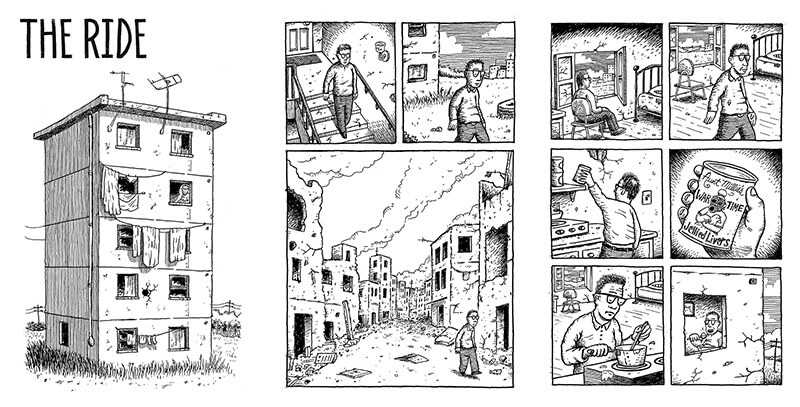
Read image description
The comic is titled The Ride. A tall, worn apartment building appears on the left, with laundry hanging from windows and a satellite dish on the roof.
The middle section follows a man as he leaves a building, walks across an outdoor area and continues down a narrow, run-down street lined with damaged buildings.
The right section shows the man inside his apartment. He enters a sparsely furnished room, opens a cabinet, removes a can labeled “Sweet Things in Vinegar Sauce: Jellied Livers,” cooks at the stove and sits down to eat. The humor comes from the bleak setting and the unappetizing meal being treated as ordinary.
“Scary Gary,” which ran until 2025, had a cult following and a loyal fanbase.
“In 2015, Jack Black and his production company, Electric Dynamite – along with Warner Brothers – expressed an interest in turning ‘Scary Gary’ into an animated TV series,” Buford blushed. “We presented a five-year option deal and pitched a pilot episode to all the major networks. Unfortunately, as option deals tend to languish, nothing came of it, but it was exciting to have objective recognition of my work.”
He’s also submitting to The New Yorker.
Single-Panel Cartoon Samples
These single-panel cartoons show Buford working in a different format, where the entire joke has to land in one image and one caption.
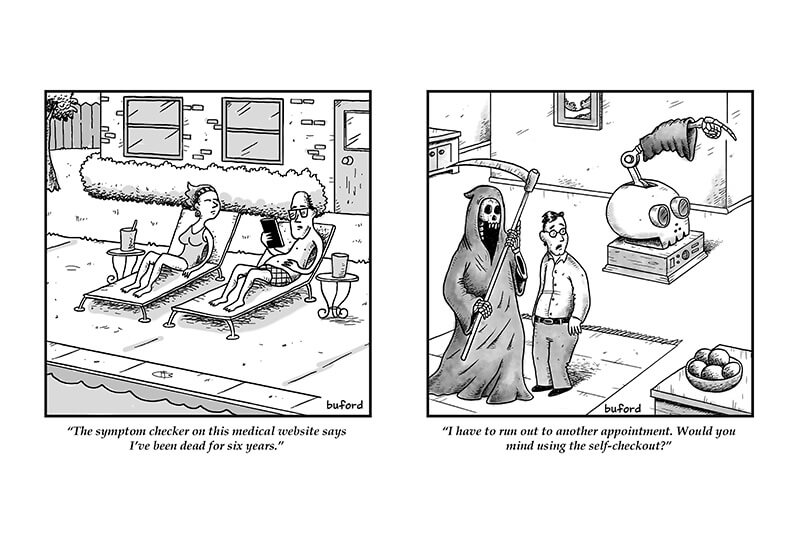
Read transcript and image description
Cartoon 1
A couple relaxes in lounge chairs beside a pool. One person looks at a phone.
Caption: “The symptom checker on this medical website says I’ve been dead for six years.”
Cartoon 2
The Grim Reaper stands beside a nervous man in a room. A skull-shaped self-checkout machine sits nearby.
Caption: “I have to run out to another appointment. Would you mind using the self-checkout?”
“Creating single panel cartoons is yet another completely different animal than a comic strip with regularly occurring characters,” he admitted. “When coming up with a single panel idea, I must switch from characters with predictable behavior to characters behaving unpredictably in the moment.”
That shift – from predictable monster gags to deeper, character-driven humor – reflects Buford’s understanding of human behavior, an approach that has influenced his work ever since, with roots he traces back to his time at UWG.
“UWG was a great experience for me,” he concluded. “Always the shy, introverted type, I was able to bloom and evolve socially, which helped give me the confidence to explore academically. That fascination continues to this day. Character development and exploring human foibles and proclivities all leave a popcorn trail of influence leading back to my studies at UWG.”