
UWG’s Paleofeast Puts an Adventurous Spin on Modern Food Share this page
Throughout centuries, the food we know and love today has become a major staple for dinner tables. However, our current appetite for cheeseburgers and fried chicken wasn’t on the menu for humans during the pre-agricultural period. In fact, humans had a varied diet of things that we still eat today – on some level.
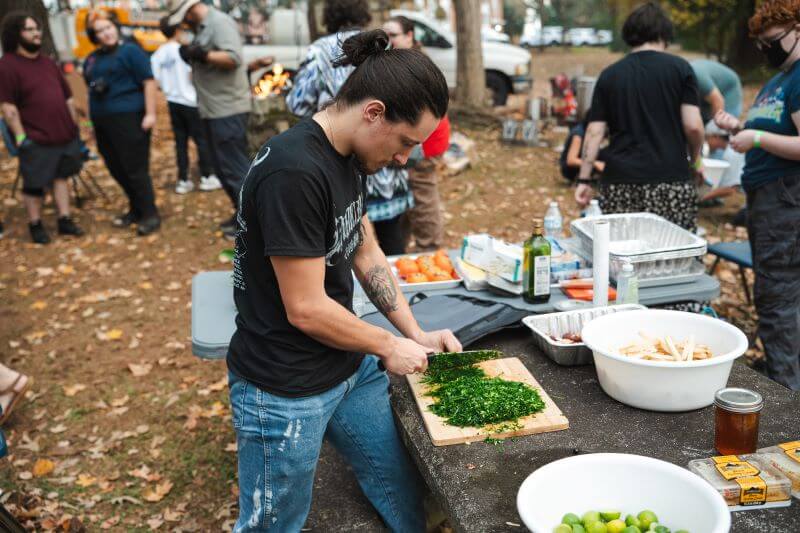
Recently, the University of West Georgia's Biological and Forensic Anthropology Laboratory (BAFAL) hosted its annual Paleofeast. The event celebrates pre-neolithic life, a period when people lived as hunters and gatherers, often relying on wild animals and plants as their source of food. This unique type of diet introduced healthy benefits for humans at the time, incorporating elements of protein and fats.
The idea of Paleofeast first came about during a lab meeting. BAFAL is an interdisciplinary lab for students who are interested in a multitude of sciences, such as primatology and evolution. Dr. Isabel Maggiano, assistant director of BAFAL and a biological anthropologist, was excited to witness students’ interest in how food evolved over time.
“Anthropology studies humans in the past and the present, and food is a very important aspect of our evolutionary development,” Maggiano said. “We wanted to celebrate together around a fire with full bellies, Paleofeast-style.”
During the festive event, Maggiano noted that students researched the menu and prepared the food, which gave them the opportunity to learn more about the foods that were commonly eaten during the pre-neolithic revolution.
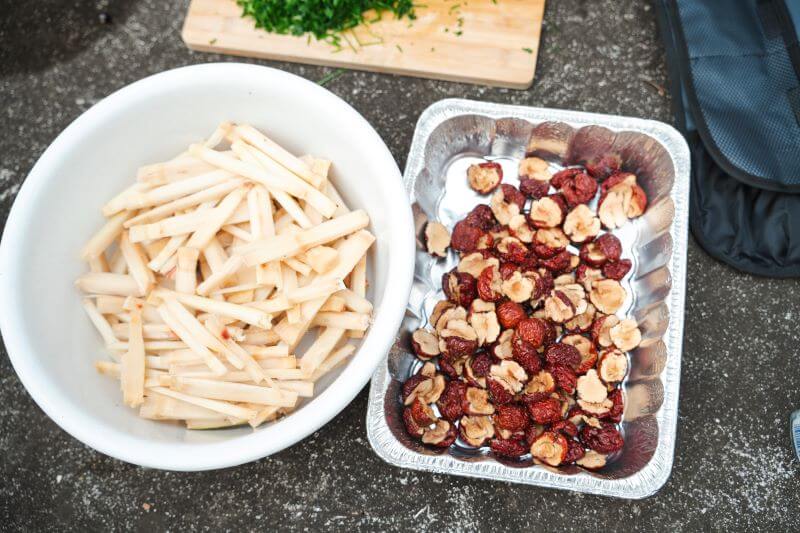
“We only serve pre-agricultural foods and cook everything on open fires,” Maggiano said. “We ate what we could hunt, catch and collect across diverse landscapes and seasons. That’s what it is to be a normal human, and, in many ways, it was healthier for our ancestors.”
At this year’s Paleofeast, the menu was filled with exotic-inspired cuisine, such as quail, gator swamp stew and oyster mushroom broth. The event tends to attract a significant crowd of people, with this year’s turnout totaling up to over 70 guests of students, faculty, staff and community members.
With how massive Paleofeast has become over the past three years, Maggiano hopes that the tradition can hopefully become a course and help students to live outside their comfort zone.
“Each year, we learn a little better how to adjust to the growing interest and how to run things smoothly,” she shared.