
From Childhood Dreaming to the American Astronomical Society: UWG Student Reaches for the Stars Share this page
Physics is one of the most demanding academic disciplines – a field that challenges a student to understand and master advanced mathematics, scientific reasoning and analytic thinking. It may be difficult for some, but for others, it becomes less of a burden and more of a calling. University of West Georgia physics student Josh Whitman is here to prove that it’s more than just a major; it’s a lifelong pursuit rooted in curiosity.
As a child, Whitman’s fascination came about when his mother worked for NASA at the nearby Wallops Flight Facility in Virginia. Growing up, he was immersed in the excitement of space exploration firsthand.
“I have fond memories of attending NASA open house events and watching from Assateague Island as sounding rockets launched from the facility,” Whitman said.
Years later, his childhood wonder led him to purchase a telescope and begin exploring the night sky on his own.
“Seeing the scale of our universe for myself only expanded that curiosity,” Whitman explained. “When I made the decision to return to college, I learned about the research being done by other students at UWG and knew I wanted to be involved.”
That drive led Whitman to astronomy, taught by Dr. Nicholas Sterling. The course was a turning point for him, as academic interest quickly grew into a meaningful mentorship and research partnership.
“I knew that I wanted to learn everything I could about our universe,” Whitman said. “For the first time [I] saw myself genuinely pursuing my interests academically instead of as a passing curiosity.”
Together, Whitman and Sterling embarked on a research project studying the infrared spectra of planetary nebulae to better understand how stars produce heavy elements.
“At the end of their lifetime, stars with masses between one to eight times that of the sun can experience a second red giant,” Whitman explained. “In this phase, heavy metals can be formed through slow neutron capture – known as the s-process – and dredged up from the area surrounding the star’s core.”
The duo conducted observations of four planetary nebulae using the 6.5-meter Baade telescope in Chile for two observation sessions in February and July of 2025. They also used the folded port InfraRed Echellette (FIRE) instrument, which captured near-infrared data spanning 0.83 to 2.5 microns.
“The data from these observations were processed to reveal emission lines,” Whitman said. “We measured these emission lines to calculate their intensity and wavelengths. This data was then used to calculate ionic and total elemental abundances.”
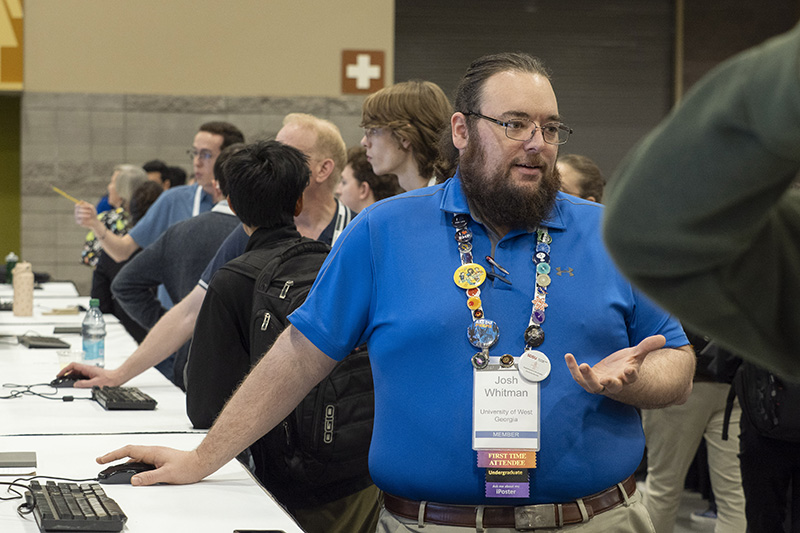
As their findings aligned the expectations of the research, Whitman later earned a spot at one of the largest prestigious meetings for scientific presentations – the 247th meeting of the American Astronomical Society. The response that he received was phenomenal.
“I received a lot of engagement and positive feedback from people who attended my poster presentation,” he recalled. “Researchers studying other aspects of red giant stars and those who study rapid neutron capture were particularly interested in my research.”
Beyond his presentation, the experience gave Whitman an insider on the collaborative world of professional science.
“Engaging with other researchers helped me better understand where our work fits in with other research being done,” he said. “I was able to network with other undergraduate and graduate students from across the country and see the collaborative process of scientific research in action.”
Now, Whitman’s sights are set on the next chapter. His goal is to finish his research by furthering analysis of existing data, processing additional data from other instruments and ultimately publishing the work with Sterling.
“Throughout this research, I learned a lot about the software and computational pipelines used for analyzing and modeling astronomical data,” he said. “In the future, I would like to work on a project using or developing new computer models and simulations to study stellar interiors and stellar formation.”
Following his time at UWG, Whitman has plans to attend graduate school and obtain a Ph.D. He is also open to exploring other areas of astronomy research and developed a better understanding of the universe.
“I will have my sights set on schools that have a strong astrophysics program,” he said. “After grad school, I want to continue doing research and I would like to teach physics and astronomy.”
For Whitman, his journey from watching the stars in the sky to presenting at a national astronomy conference is only the beginning.