
A Faster, Smarter BSN: UWG Offers Streamlined Nursing Program Share this page
The University of West Georgia’s Tanner Health School of Nursing (THSON) is launching a more streamlined, student-centered curriculum designed to meet the region’s growing demand for highly skilled nurses. By refining course sequences, strengthening clinical preparation and removing barriers to timely graduation, the updated Bachelor of Science in Nursing (BSN) program will help students enter the workforce sooner and equipped with the knowledge, confidence and compassion to serve communities.

“This redesign is not about doing less,” said Dr. Susie Jonassen, assistant professor and assistant dean of prelicensure nursing. “It’s about teaching differently and teaching better. It doesn’t reduce rigor; it restructures where rigor occurs.”
The revised BSN curriculum reduces the program from six to eight semesters down to four, and it streamlines total credit hours from 66 to 60. Jonassen explained that the move was driven primarily by evolving national nursing education standards and regional workforce needs.
But the transition was first imagined when the American Association of Colleges of Nursing (AACN) changed how pre-licensure nursing education is expected to be structured in 2021. Widely used to benchmark quality in nursing education, the AACN Essentials specify the core curriculum content and competencies that students must demonstrate across all academic levels, from baccalaureate to doctorate.
“The Essentials emphasize competency-based education, clinical judgment and practice readiness rather than accumulation of credit hours or course silos,” Jonassen said. “Our prior curriculum was built around a traditional, content-heavy model. While academically sound, it wasn’t optimally aligned with how new nurses are expected to practice in modern healthcare systems.
“At the same time, our regional healthcare partners identified an urgent need for practice-ready graduates who can function safely in increasingly complex patient environments immediately upon hire,” she continued. “Hospitals are caring for higher-acuity patients, and nurse residency programs are now built around clinical judgment, prioritization, teamwork and communication. Our curriculum needed to intentionally develop those competencies.”

Benchmarking across the University System of Georgia nursing programs demonstrated that maintaining a longer, higher-credit curriculum placed students at a competitive disadvantage without providing additional licensure or practice benefit. The new model allows UWG to remain competitive while still meeting institutional missions of access and community impact.
THSON also carefully examined various barriers faced by its students, of which many applicants are working adults, first-generation college students or individuals balancing family responsibilities. Extended program timelines, summer requirements and unnecessary credit loads were contributing to financial strain, delayed graduation and attrition. The revised four-semester structure removes those barriers while preserving educational depth.
“The primary benefit is increased access without decreased quality,” said Jonassen, who recently received a $30,000 grant through Affordable Learning Georgia to help transition all first-semester book resources to open access resources that will save each student approximately $4,500 totaling to a savings of over $1 million each calendar year. “Removing summer semesters is particularly important. Many students rely on summer employment to support themselves and their families. The previous model sometimes forced students to choose between work and school. The new structure supports sustainability and retention.”
The move from only a summer start to admitting Fall and Spring semesters also offers more entry points for the program and allows THSON to leverage more scholarships, especially in a student’s first semester.
The reduced credit load also allows students to focus on mastering essential competencies rather than managing excessive coursework. Students will also benefit from smaller cohorts that allow closer faculty mentorship, earlier identification of academic concerns and stronger professional development.
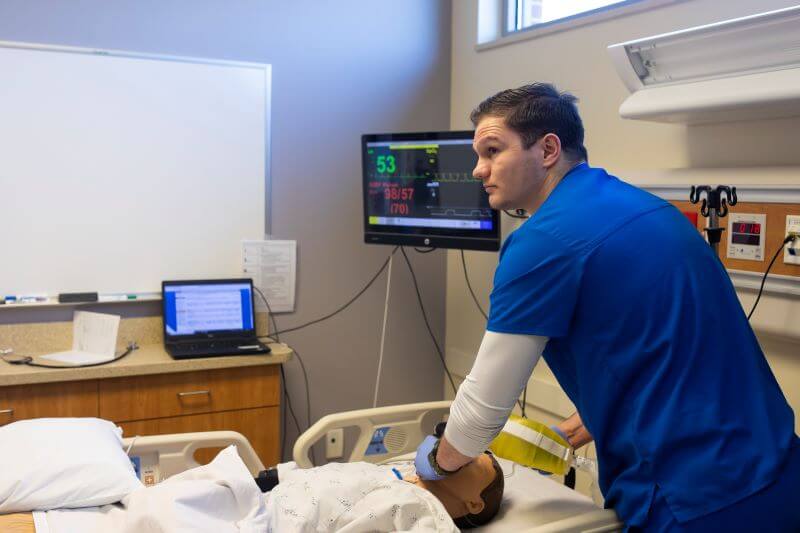
“Nursing education is intensive by nature,” Jonassen informed. “When the schedule becomes overloaded, students shift from learning to simply surviving. The revised curriculum protects time for preparation, clinical reflection and skill development.”
Jonassen also pointed to reinforced workforce pipelines.
“Our curriculum incorporates quality improvement, population health, informatics and interprofessional communication, which are all core workforce expectations,” she concluded. “This is not a local change. It’s part of a national shift in how nurses are educated. Our message is simple: we’re preparing the nurse that healthcare needs today, not the nurse needed 20 years ago.”
If you are interested in enrolling at UWG’s Tanner Health School of Nursing, applications are open twice a year: the current cycle for Fall semester closes on May 1 and the Spring semester opens in July. Visit westga.edu/nursing to learn more.