
framing nasa's artemis II
How One UWG Alumnus Turned a Distant Lunar Flyby into a Shared Human Moment Share this page
The astronauts of Artemis II’s 10-day voyage rewrote the boundaries of human distance. And behind every image beamed back from that record-breaking arc was a University of West Georgia alumnus whose job was to make the impossible visible.
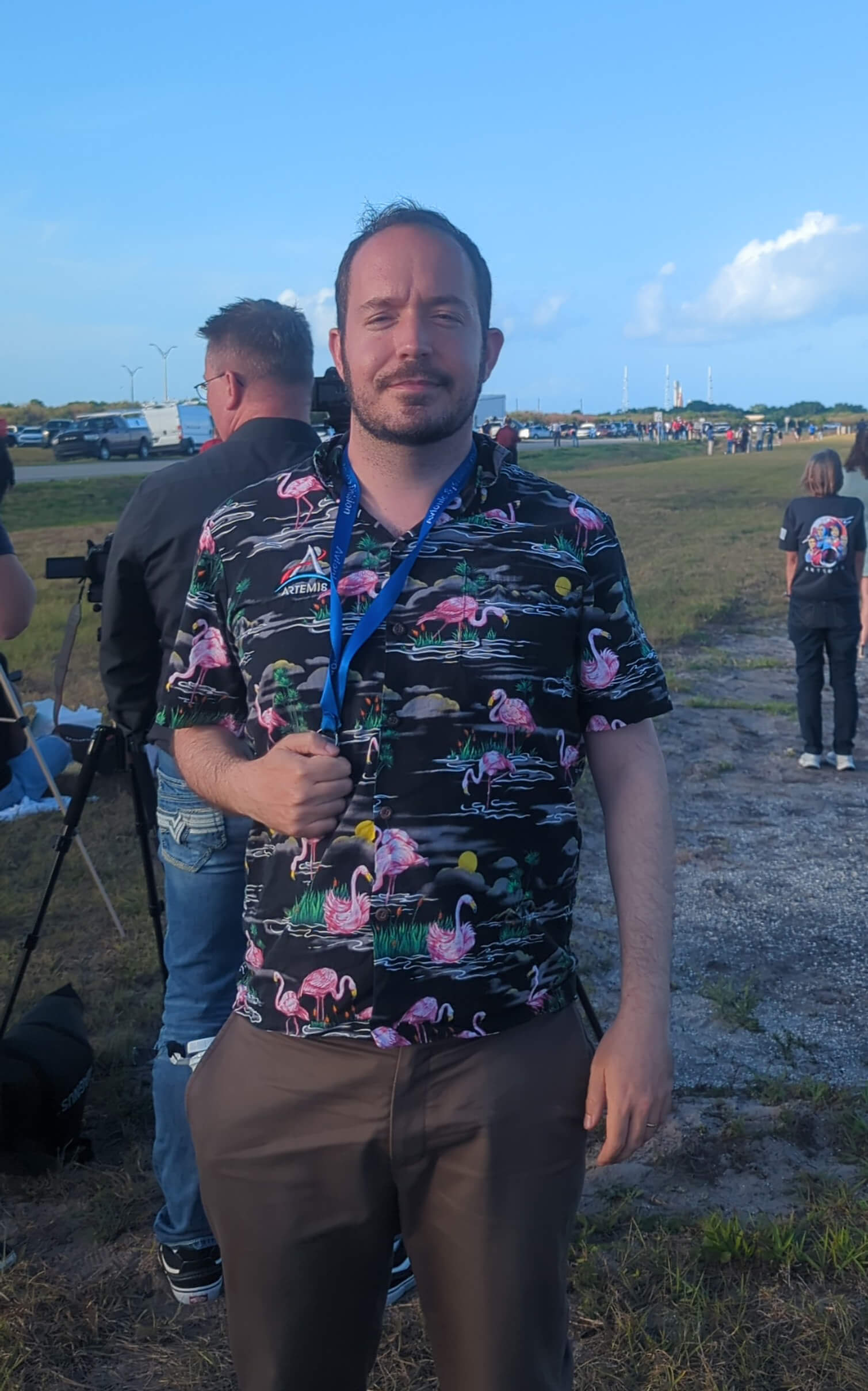
From NASA’s Johnson Space Center in Houston, Roger Lascorz ’14 helped shape how the world would see Artemis II. As the first crewed lunar flyby since Apollo 13 in 1972, the mission never touched the moon’s surface, but through Lascorz’s work overseeing its imaging systems, it didn’t have to. Charged with overseeing every frame captured on the lunar surface, he shaped a visual language where science, engineering and human wonder intersect, ensuring that when humanity returns to the moon, we don’t just arrive; we understand what we’re seeing.
“I always describe it as the eyes of the mission,” said Lascorz, who will receive the Perry College of Mathematics, Computing and Sciences Achievement Award later this month during UWG’s annual Alumni Weekend. “When you’re talking about a spacecraft or the lunar surface, your cameras are your eyes. Engineers are looking at images right alongside the technical data. Sometimes a number tells you something is wrong, but the image tells you why. You need both.”
Lascorz, who has been at NASA since 2019, pointed to the specific scenario of a launch as to why this imagery matters.
“In those final moments before liftoff, engineers are watching dozens of things at once,” he explained. “If something looks off on a camera – a frost pattern that shouldn’t be there or a seal that doesn’t look right – that visual can be the difference between going and standing down. It’s not a flashy part of the job, but it matters so much.”
The lifecycle of a single piece of imagery, from capture to operational use, is one of survival, Lascorz informed. Launch and the lunar environment itself can be very harsh, and many engineers work hard to ensure the hardware can handle the load. The data then has to be transmitted, which is also tricky considering bandwidth limits and signal delays. Once it hits the ground, it’s processed, routed to the right teams and displayed in a way people can use quickly.
“A lot of really smart and dedicated people are involved, and there are many things that have to go right,” he said. “You design for robustness, you test a lot and you build backups wherever you can. It’s a big responsibility.”
“UWG gave me my foundation in physics, which has been way more useful than I ever expected in an engineering role. Physics teaches you to think from first principles, so when something isn’t behaving the way it should, you go back to basics and reason it through.”
“These astronauts are real people – that keeps you from cutting corners,” he continued. “It’s also deeply motivating, and I feel lucky to contribute to projects like this.”
What did success look like for Lascorz when Artemis missions were underway? The answer might be surprising to some.
“Silence,” he sighed. “Success for me was sitting there watching the mission unfold on the big screen with absolutely nothing urgent to do because the systems we spent years building were quietly doing their jobs. That calmness is everything. It’s the best feeling.”

The Catalonia, Spain, native has been with NASA since 2019. Working for the space program, coupled with the unique opportunity of starting college early, was why he came to the United States as a 16-year-old international student at UWG’s Advanced Academy in the first place, Lascorz told UWG News in a 2022 interview.
“UWG gave me my foundation in physics, which has been way more useful than I ever expected in an engineering role,” he shared. “Physics teaches you to think from first principles, so when something isn’t behaving the way it should, you go back to basics and reason it through.”
One professor was particularly impactful for the younger Lascorz.
“[Professor Emeritus of Physics] Dr. [Javier] Hasbun brings out the best in people and genuinely cares about his students,” Lascorz recalled. “He challenged me at a time when I was young, and that meant the world to me. The UWG physics program is fantastic, and the quality of teaching and spirit of curiosity there are something special. Being at a smaller university also meant I had real access to professors and hands-on research early on, which was huge. I owe a lot to UWG and the people there.”
Images and descriptions below are courtesy of NASA.
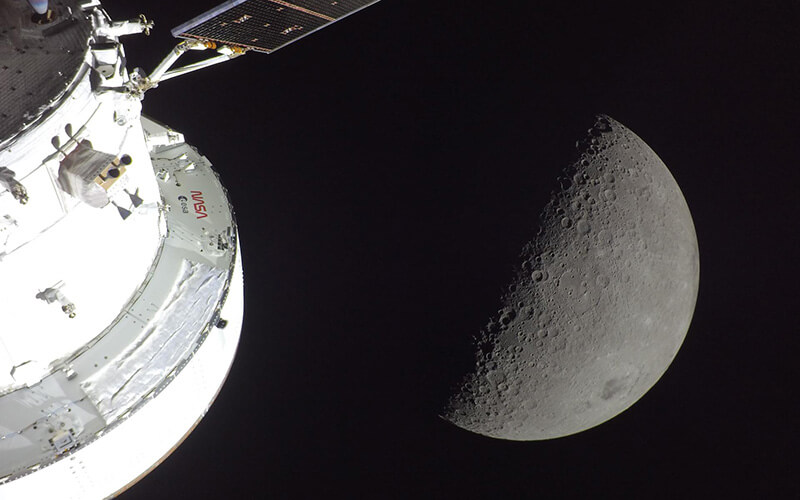
NASA’s Orion spacecraft is seen in the foreground, lit up by the Sun. A first quarter Moon is visible behind it, with sunlight coming from the right. Near the bottom right edge of the Moon, Orientale basin stands out with a black patch of ancient lava in its center. A 600-mile-wide impact crater ringed by mountains, Orientale straddles the near and far sides of the Moon. Credit: NASA
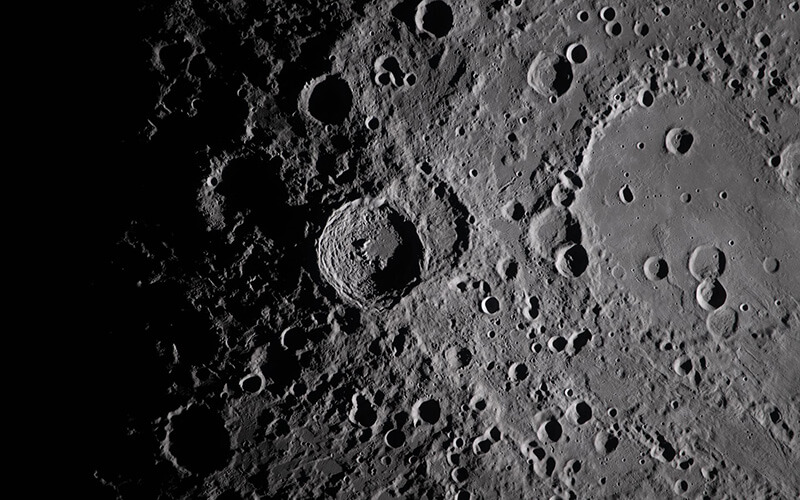
A close-up view taken by the Artemis II crew of Vavilov Crater on the rim of the older and larger Hertzsprung basin. The right portion of the image shows the transition from smooth material within an inner ring of mountains to more rugged terrain around the rim. Vavilov and other craters and their ejecta are accentuated by long shadows at the terminator, the boundary between lunar day and night. The image was captured with a handheld camera at a focal length of 400 mm, as the crew flew around the far side of the Moon.

The Moon, backlit by the Sun during a solar eclipse, is photographed by NASA’s Orion spacecraft on April 6, 2026, during the Artemis II mission. Orion is visible in the foreground on the left. Earth is reflecting sunlight at the left edge of the Moon, which is slightly brighter than the rest of the disk. The bright spot visible just below the Moon’s bottom right edge is Saturn. Beyond that, the bright spot at the right edge of the image is Mars. Credit: NASA
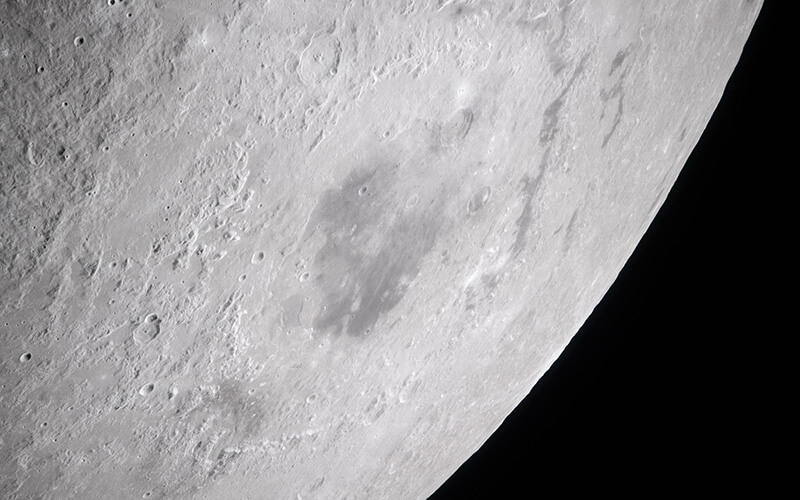
During the lunar flyby observation period, the Artemis II crew captures a detailed image of the Orientale basin, a 600-mile-wide impact crater marked by a dark patch of ancient lava that erupted through the Moon’s crust billions of years ago. Credit: NASA
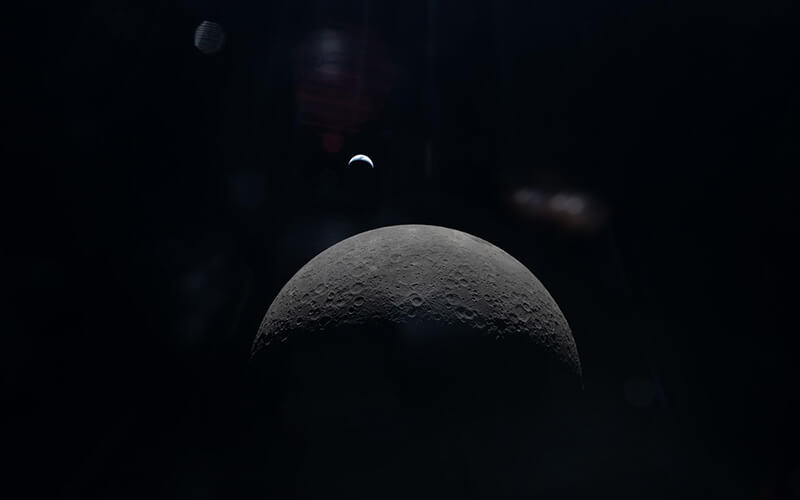
The Artemis II crew captures a faint view of a crescent Earth above the horizon on the Moon’s far side. Credit: NASA
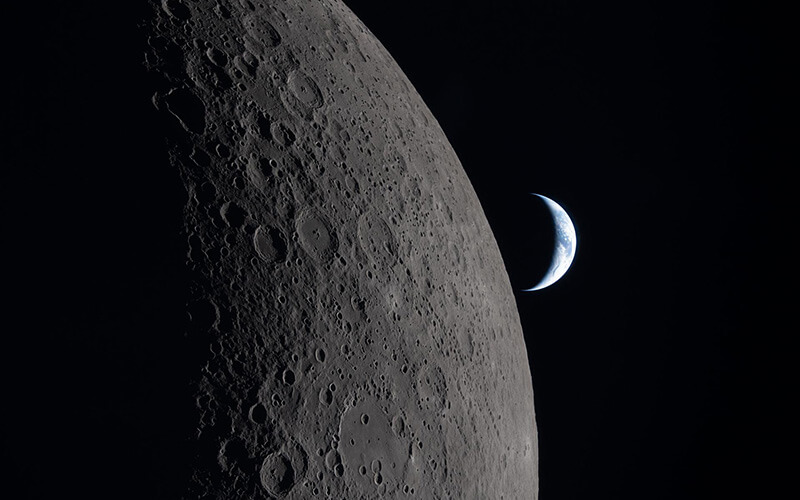
As the Artemis II crew came close to passing behind the Moon and experiencing a planned loss of signal, they captured this image of a crescent Earth. Seen from afar, it almost looks like a circular arc – except when backlit, as in other images captured by the Artemis II crew. Earth is in a crescent phase, with sunlight coming from the right. The dark portion of Earth is experiencing nighttime. On Earth’s day side, swirling clouds are visible over muted blue in the Australia and Oceania region. Credit: NASA
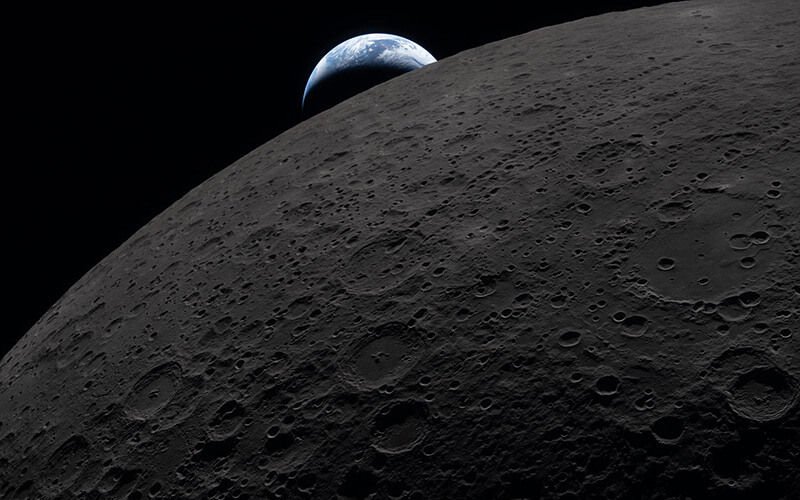
Earthset captured through the Orion spacecraft window at 6:41 p.m. EDT, April 6, 2026, during the Artemis II crew’s flyby of the Moon. A muted blue Earth with bright white clouds sets behind the cratered lunar surface. The dark portion of Earth is in nighttime. On Earth’s day side, swirling clouds are visible over the Australia and Oceania region. Credit: NASA
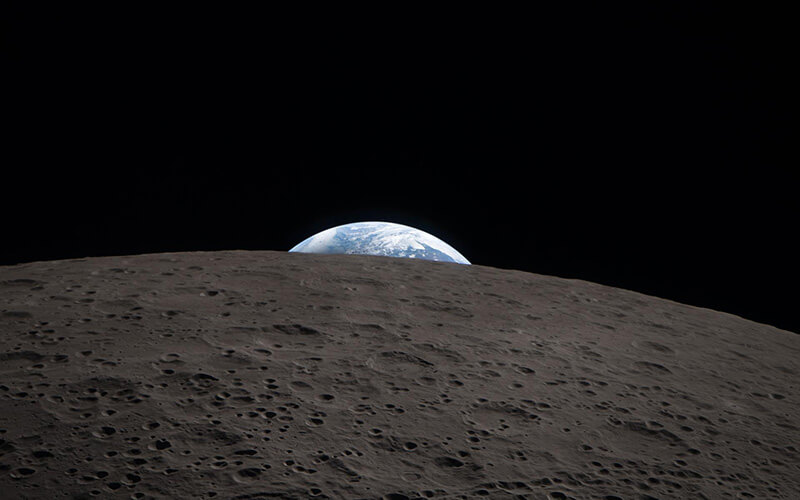
Echoing the iconic Earthrise photo captured by the Apollo 8 astronauts in 1968, during the lunar flyby, the Artemis II crew captured a shot of Earthset as they passed behind the Moon’s far side. It is one of many photos taken during the seven-hour lunar flyby by the Artemis II crew on the Orion spacecraft. Credit: NASA